Turn Bank Statement to Excel (Free & Fast) — No Manual Entry
Published on December 15, 2025
The Definitive Guide: How to Turn ANY Bank Statement PDF into Usable Excel Data
Stop struggling with manual data entry and broken tables. Learn the process, and see why AI is the only secure solution for clean **PDF to Excel bank statement** conversion.
Ready to Skip the Pain? Use the AI Now.
Upload PDF to Convert 1 Page Free → Get Excel FileFree conversion for the first page. Processed using the Zero-Retention Protocol for absolute privacy.
The Copy-Paste Nightmare: Why Manual Data Entry Fails
When you search for **"how to turn bank statement into excel,"** you are looking for an escape from hours of tedious, error-prone data entry. Accountants, bookkeepers, and analysts know the harsh truth: Bank statement PDFs are designed to be read, not processed.
The inherent challenges of manual conversion:
- **Broken Tables:** PDFs often use complex, nested table structures that break when copied, merging dates, descriptions, and amounts into one column.
- **Misread Scans:** Generic OCR tools fail on low-resolution or scanned statements, leading to transaction amounts being skipped or misread.
- **Date Formatting Hell:** Trying to unify dozens of different date formats (DD/MM/YYYY vs. MMM DD, YYYY) is a manual, repetitive task that introduces costly errors.
Expert Note: A single error in a bank statement can lead to hours of reconciliation or—worse—inaccurate financial reporting. The ROI on manual entry is always negative.
The Generic Tool Trap: Why Your Free PDF Converter Breaks Financial Data
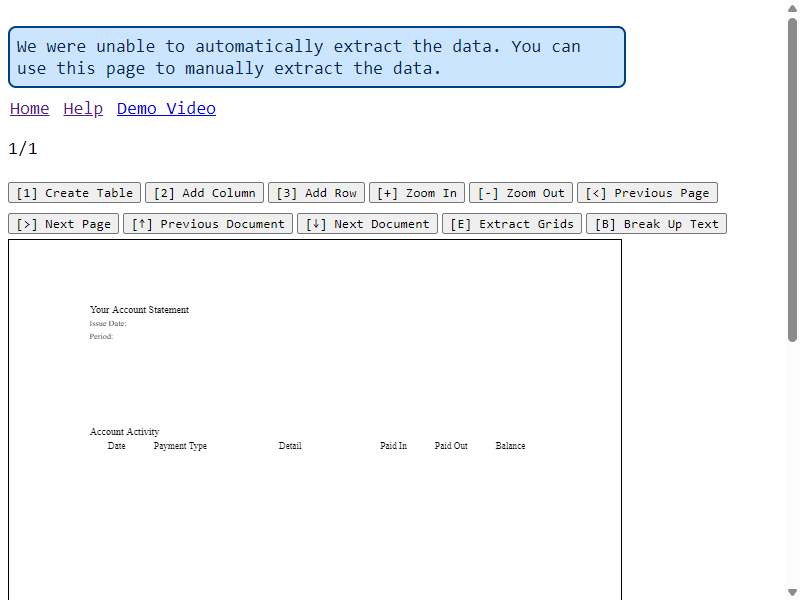
A standard **PDF to Excel converter** is trained on invoices and general documents, not high-stakes financial tables. They cannot apply financial logic, which is critical for accurate extraction.
❌ Problem: Generic Converter Output
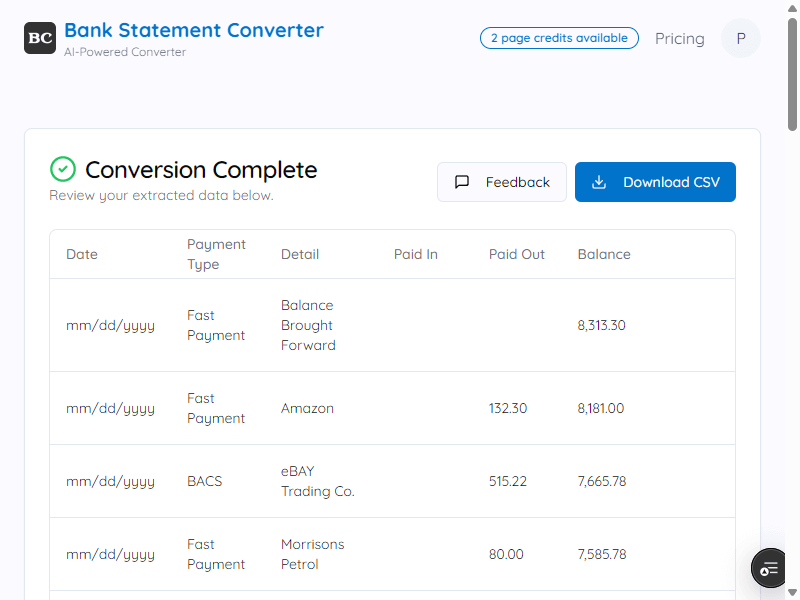
✅ Solution: Bank Statement Converter AI Output
The True "How-To": Leveraging AI for 99.9% Accurate Bank Statement Conversion
The only way to consistently **convert a bank statement to excel** is by using dedicated bank statement converter software trained on millions of financial documents.
Our AI focuses on three critical steps that bypass all manual and generic tool failures:
1. Transaction Block Detection (E-E-A-T)
We don't just read the PDF; we use machine learning to identify the precise boundaries of the transaction table, even when the statement layout is complex or broken. This guarantees accurate **data extraction**.
2. Transaction Cleaning & Standardization (Security)
Dates are standardized (YYYY-MM-DD), and transaction descriptions are cleaned of unnecessary line breaks. All processing is done using our Zero-Retention Protocol, meaning your sensitive data is **never stored**.
3. Direct Accounting Software Readiness (Authority)
The output isn't just an Excel file; it's a **structured financial dataset** designed to be drag-and-dropped directly into QuickBooks, Xero, or any advanced accounting platform. Zero manual column mapping required.
The Final Step: What to Do with Your Clean Excel Data
The power of **turning your bank statement into Excel** isn't just in the conversion; it's in the automation that follows. Your new spreadsheet is ready for:
- **QuickBooks Reconciliation:** Upload your file directly for instant matching and reconciliation.
- **Pivot Table Analysis:** Quickly create reports, track spending categories, and identify anomalies.
- **CSV Formatting:** If you need a different format, you can use our CSV File Converter to quickly adjust the output for complex financial models.
Ready to Automate Your Bookkeeping?
Stop wasting hours on manual data entry. Get a perfectly formatted Excel statement in seconds.
Convert Your First Page Free TodayTurn bank statement into Excel without the usual mess
Turn bank statement into Excel is the job that sounds simple until you are 20 minutes in and Excel is full of merged columns and random line breaks.
If you have ever copy pasted a statement and then spent hours fixing it, you are not doing it wrong.
PDFs are just not built for clean data.
Here is what I have noticed with real users.
You are not looking for an Excel file.
You are looking for a spreadsheet you can actually trust.
The real worries people have before they convert
- I cannot afford a single wrong transaction amount. Reconciliation becomes a nightmare.
- My statement is a scan. Most tools choke on it.
- The layout is weird. Multi line descriptions, wrapped text, or running balance in the middle.
- I do not want my bank data stored somewhere. Uploading feels risky.
- I need CSV as well. Because accounting tools love CSV imports.
If you want the fastest route, you can run the conversion directly in my tool here.
It is built for bank statement tables, not generic PDFs.
Use it when you want Excel or CSV that is ready for sorting, filtering, and matching.
Turn bank statement into Excel the boring way vs the smart way
Let me be a bit sceptical here.
A lot of advice online is basically: copy it into Excel, then tidy it up.
That works for a tiny statement with a perfect digital PDF.
It breaks the moment you are dealing with real life.
Method
When it is fine
When it hurts
Copy paste
Fast but fragile
One page, clean table, no wrapped text
Most bank statements, most of the time
Excel import
Better, still needs cleanup
Digital PDFs with consistent tables
Scans, rotated pages, odd spacing, multi currency
Bank focused converter
Built for statements
When you need speed and fewer mistakes
Still do sanity checks, but you start with clean columns
Before you convert, do these 60 second checks
These quick checks improve accuracy no matter what method you use.
They also save you from blaming the converter when the PDF itself is the problem.
Check 1: is it a scan or real text
Try selecting a transaction line inside the PDF.
If you cannot highlight text, it is likely a scan.
Scans can still convert, but they need stronger extraction.
Check 2: does the table wrap descriptions
Descriptions like card payments often wrap across lines.
That is where generic PDF to Excel tools usually split one transaction into two rows.
Check 3: which columns exist
- Date
- Description
- Money out and money in, or a single amount column
- Balance
Knowing this upfront helps you spot missing columns after conversion.
Check 4: are there multiple accounts in one PDF
Some PDFs include two accounts, or a statement plus a summary page.
Those summary pages can pollute your spreadsheet unless you filter them out.
My blunt rule
If your PDF is a scan, or if descriptions wrap, do not waste time with copy paste.
Go straight to a converter that is designed for bank statements.
How I turn a bank statement into Excel, step by step
This is the workflow I recommend if you want reliable output and you do not want to babysit Excel.
No jargon.
Just steps that work.
-
1. Upload the PDF to the converter
I use BankStatementConverterAI because it is built around bank statement tables.
You upload, pick Excel or CSV, and download the file. -
2. Open the Excel file and freeze the header row
It sounds small, but it changes everything when you are scanning for mistakes.
If your header row is not a single clean row, pause and fix that first. -
3. Run the two sanity checks
- Row count check. Does the number of transactions look roughly right for the date range.
- Balance logic check. Pick 5 random rows and verify the balance moves correctly.
If both checks pass, you are already ahead of most manual conversions.
-
4. Clean the boring stuff once
I do these quick tweaks and then save a clean version.
- Format the date column as a date, not text
- Format amount columns as numbers
- Trim leading spaces in the description column
- Remove completely blank rows
-
5. Export CSV only if you need to import into accounting software
Excel is great for analysis.
CSV is great for imports.
If your next step is bookkeeping software, save as CSV after the data looks clean.
Want the shortcut
If you are doing this weekly, do not build a fragile routine around copy paste.
Just convert the statement properly at the start.
Convert bank statement PDF to Excel here.
The stuff that usually breaks during bank statement PDF to Excel conversion
If you want your content to feel real, this is the section that does it.
Because these are the things people actually hit late at night when they are trying to close the books.
Wrapped descriptions
One transaction becomes two rows.
You notice later when your totals do not match.
A bank focused converter should keep the full description together.
Minus signs and brackets
Some statements show negatives as minus values.
Some use brackets like (12.34).
After conversion, make sure Excel treats them as numbers, not text.
Thousands separators and currency symbols
A value like 1,234.56 can become text if the comma is misread.
Same with pound signs glued to the number.
Fix the number format once, then copy it down the column.
Running balance column
Balance is your best friend for validation.
If the balance column disappears or shifts, you lose the easiest accuracy check.
Multi currency statements
You might have original currency, exchange rate, and GBP amount in one statement.
Do not merge those into one number column.
Keep them separate so you can audit later.
What to do after you turn a bank statement into Excel
This is where most guides stop.
And this is also where most errors hide.
So here is the post conversion checklist I actually use.
Post conversion checklist
Totals check
- Sum money in
- Sum money out
- Compare with statement totals if shown
Duplicates check
Sort by date and amount.
Scan for repeated rows.
Duplicates happen when a wrapped line gets misread.
Date range check
Filter the date column.
Make sure the first and last transaction match the statement period.
Balance spot check
Pick 5 rows.
Confirm balance moves by the transaction amount.
This catches silent errors fast.
Quick win for bookkeeping
Add a new column called Category.
Then you can tag transactions as you go.
Later you can pivot by category and month in seconds.
FAQs about turning bank statements into Excel
Can I turn a scanned bank statement into Excel
Yes, but scans are the hardest type.
If your PDF is image based, you need extraction that can read the table properly.
If you want to try the fast route, use the converter on bankstatementconverterai.online.
Should I choose Excel or CSV
Choose Excel if you want to analyse, filter, and build pivots.
Choose CSV if you want to import into another system.
A lot of people do both, Excel for checking, CSV for uploading.
Why does my PDF to Excel conversion split one transaction into multiple rows
Usually because the description wraps across lines, or the PDF table has invisible spacing that confuses generic tools.
This is exactly why bank statement specific converters exist.
How do I know the converted Excel is correct
Do not rely on a quick glance.
Use the balance spot check and a totals check.
If balance and totals behave, you are in a good place.
What is the fastest way to turn bank statement into Excel
Use a bank focused tool and then run two sanity checks.
If you want the quickest workflow, start here: BankStatementConverterAI.
If you are done fighting PDFs
Upload the statement, download Excel or CSV, and move on with your day.
No drama.
No broken rows.
